Trust through facts
Defect logging with photos: the customer sees why, not just what
“The pads need replacing” is a claim the customer has to take on trust. A photo of a pad worn to 75%, with a category, a priority and a recommendation attached, is evidence. The difference between the two is measured in arguments at handover.
Trust through facts
Diagnostics & inspections
The mechanic logs defects and recommendations right inside the work order: component condition, wear percentage and photo evidence. The customer sees why, not just “needs replacing”.
- Condition statuses: Monitor · Recommended · Critical
- Recommendations become work order lines in one tap
- Photo evidence — before and after
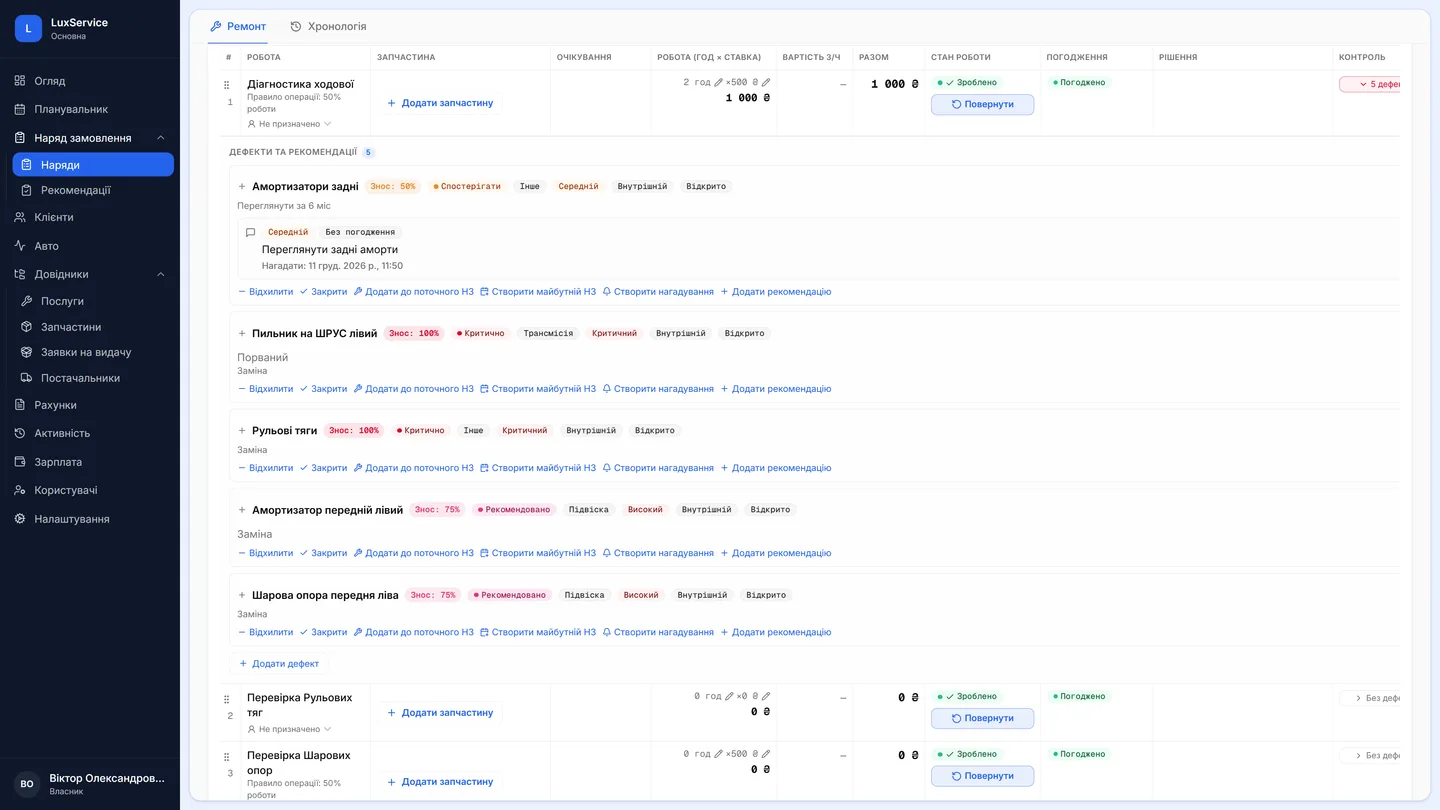
What a defect record holds
Any job can carry an unlimited number of defects. A defect record holds a category, a name, a priority, a wear level, a description, a recommendation, photos, a comment and a “visible to customer” flag.
The categories cover the whole car: engine, transmission, suspension, brakes, electrics, body, tyres, servicing and other. Wear is set with quick buttons — 25%, 50%, 75%, 100% — or by hand when the mechanic wants to be more precise.
- RecommendationReplace pads and discs
- Visible to customerYes
Internal, or visible to the customer
Not everything a mechanic notices should go straight to the customer. So each defect is either internal or visible to the customer — and only customer-visible defects reach the approval step.
That hands the service advisor control of the conversation. Something worth noting for next time stays inside. Anything affecting safety or the bill goes out with a photo and a recommendation — and stops looking like an attempt to pad the job.
- Scuff on the sump guard
- Worth a look at the next service
- Pads at 75% — sent for approval
- Photo and recommendation attached
From a defect into a job
A defect with no consequence is just a note. A recommendation logged during diagnostics becomes a line on the order: add it to the work list and send it for approval along with everything else.
What the customer declines today doesn't disappear. The defect stays in the car's history, so next time it's visible that the suspension was already flagged six months ago — and how that conversation ended.
Questions & answers
Frequently asked questions
Does the customer see every logged defect?
No. A defect reaches the customer only if it carries the “visible to customer” flag. Everything else stays internal to the shop.
How many photos can a defect have?
There's no cap on the number of defects per job, and each defect carries its own photos and comment. Mechanics shoot them from a tablet or phone right inside their workspace.
Is there a standalone diagnostics module?
Defects and recommendations are logged inside the work order, in the context of a specific job, rather than in a separate section. That way a defect is tied to the job, the mechanic and the car from the start.
How a defect reaches approvalThe mechanic's workspaceWhat the car owner sees